Clogher
High Crosses, Bullauns and Cross/Sundial
It is traditionally believed the early monastic site at Clogher was founded in the 5th century by a disciple of St Patrick, St Macartan (Irish: St Aedh Mac Cairthinn c.430-505CE). Standing in the graveyard, to the west of the cathedral, are two sandstone crosses. The tallest, or south cross, stands 2.75 metres high, part of the shaft is missing, see image above. The east face bears two rectangular panels with a series of bosses and the head features a single boss at the centre. The west face bears two panels of interlace and a single decorated boss is present in the centre of the head. The two cross heads of both of these ringed crosses are imperforate and feature volutes. The base of each cross is plain apart from roll-moulding on the edge. The same moulding appears on the edge of both shafts.


North cross west face

North cross east face

The north cross, pictured left in the image above, stands 2.3 metres high and may also be missing part of the shaft. On the shaft of the west face is a lozenge shape with interlace. At the centre of the head is a roundel with a worn carving in the centre. The east face bears a square decorated panel on the shaft. The head features a lozenge shape formed by four entwined creatures with bird like heads at the top and bottom, the legs bend onto the arms of the cross. There is another weathered motif carved in the centre of the lozenge.
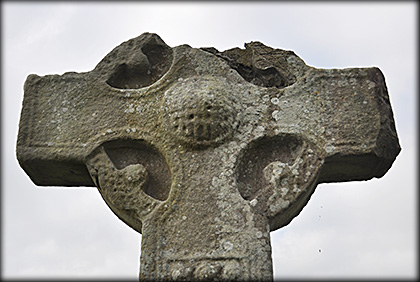
South cross east face

South cross west face
The most intriguing monument at Clogher is situated inside the cathedral. It is often described as a sundial and we can see why in the first image pictured below left. This is the side you first see as you approach the monument. The shaft is decorated with a continuous interlaced broad-band, similar to the early high cross at Carndonagh. Above the band at the widest part of the monument is a sundial, with a small rectangular piece of interlace above it. At the base of the shaft is a carving of a fish, possibly representing the salmon of knowledge. The east side of the monument, now facing north, is intriguing. Helen Roe wrote an article in 1960 suggesting it is a prototypical cross from the mid 7th century. At the top of the cross is the shape of a head, with a damaged face, see image below right. Helen suggested it represents christ. It has a large breastplate, decorated with another broad interlaced band. They look like four celtic knots.In her article Roe suggests 'We are here dealing with an example of Crucifixion by implication rather than by depiction'. In the article she shows at least four examples of stone crosses from this period, with a disembodied head of christ set over an ornamental breastplate. A excellent example is the cross at Colonsay in Scotland. There are examples also present at two Irish pilgrimage sites, Caher Island and Skellig Michael. Another small cross can be found at Kilbroney in County Down, it bears a face with an inscribed latin cross below it.
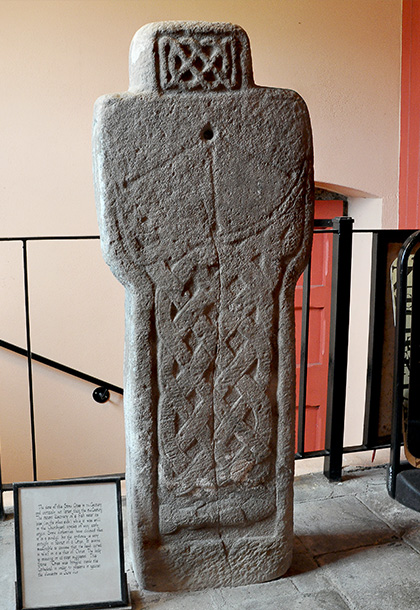
West Face
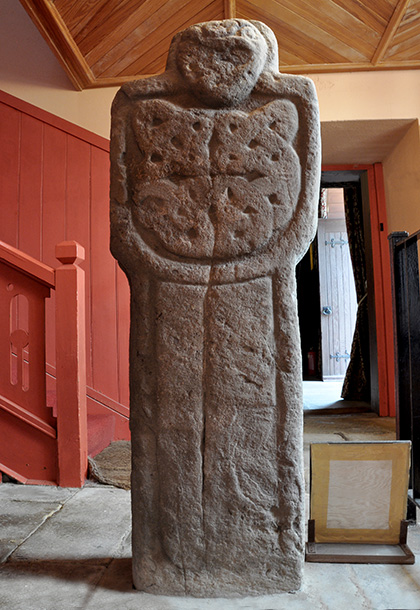
East Face
Cross shaft, Clogh-oir and Bullaun stone
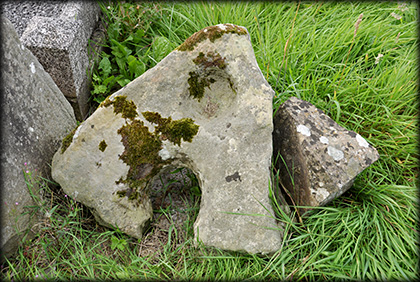
A fragment of a cross shaft, below left, stands between the two high crosses. A bullaun stone, pictured bottom, lies on the northside of the north cross. Another stone on display in the cathedral is known as the Clogh-oir or Golden Stone from which Clogher may have derived its name. The Clogh-oir, pictured below right, was one of the three stones of Erin, the other two being the Stone of Destiny and the Crom Cruach. It was famous as an oracle at Clogher during Pagan times. There is a tradition that the Clogh-oir was consulted by Concobar Mac Nessa, High King of Ulster. Taken from the information board at Clogher Cathedral. It's now believed it is probably a lintel from a doorway with inclined jambs, from a previous church. the site


Situated: At St Macartan's Cathedral, Main Street, Clogher, County Tyrone.
Discoverer Map 18: H 5371 5160. Last visit Aug 2019.
Longitude: 7° 10' 22" W
Latitude: 54° 24' 37" N
Photos: Jim Dempsey
Nearest High Crosses featured on this website
Donaghmore High Cross: 29 Kilometres ENE.
Lisnaskea High Cross: 29 Kilometres SW.
Clones High Cross: 35 Kilometres SSW.
Devenish High Cross: 37 kilometres W.
Boho High Cross: 51 kilometres W.